Posts

With a Great Cry of Scalding and Burning: The True Story Behind the Great Thunderstorm of 1638 When Fact Met Folklore in the English Moors

Image
  It is Sunday October 21, 1638 and approximately 300 worshippers are packed into St. Pancras church in the English village of Widecombe-in the-moor during the early afternoon.   The worshippers represent almost the entire able-bodied population of Widecombe.  Only a few idle church dodgers, whose souls are sure to go to Hell anyway, everyone in St. Pancras’ church believes, choose to spend their Sabbath day drinking and gambling at a tavern just a few miles outside the village.    The faithful are there in church, as they are every Sunday, to listen to the sermon of  their Anglican minister, George Lyde and to hear the Word of the Lord.  Lyde stands at the altar, as he does each week, with his faithful wife sitting attentively in the first pew only a few feet away at the very front of the church.  Little does he, or anyone else in St. Pancras that fateful afternoon know, but many there that day have only moments left to live. St. Panc...

Bloody Palm Prints and Horse Thieves: The Story of the Old West's Last Stagecoach Robbery on December 5, 1916

Image
  Ben Kuhl was born in northern Michigan sometime in the year 1884.  A school dropout with alcoholic parents, some would say that Ben Kuhl never had a chance at an honest life from the very beginning.  As a teenager he drifted west and in 1903 he was arrested for horse theft and sentenced to a term of 1 to 10 years in an Oregon state prison. It’s not known exactly how long Ben Kuhl spent in prison, but what is known for sure, is that by the year 1916 at the age of 32 Ben Kuhl had both literally and figuratively drifted his way into the remote and isolated mountain town of Jarbidge, Nevada.  Upon his arrival in town Ben took up residence in a tent with two other drifters named Ed Beck and Billy McGraw. He worked for a stint as a cook at the OK Mine, a place just outside of Jarbidge, where miners from all over the American west hoped to strike it rich by finding gold.  By 1916 the small frontier town of Jarbidge located in Elko County, Nevada only about ten mi...

A Spontaneous Demonstration of Joy with a Great Expenditure of Liquor: The Story Behind America's First Independence Day Celebration in 1777

Image
  On July 5, 1777 Philadelphia’s most widely read daily broadsheet The Pennsylvania Evening Post described the previous day’s Independence Day celebrations in the city as, “A demonstration of joy and festivities.” In an outpouring of patriotic fervor according to the Pennsylvania Evening Post , ship’s in the harbor along the banks of the Delaware River were said to be, “Dressed in the gayest manner with the colors of the United States and red, white and blue streamers displayed.” It was reported that day, that as the fittingly decorated ships approached the city--America’s newly minted first capital city of Philadelphia, Pennsylvania, that thirteen cannon shots were fired--one cannon blast for each former British colony that had only the year before turned newly independent state, part of the loose confederation now known as the United States of America. That night thirteen fireworks were set off in the large green spaces known as the city commons of both Philadelphia, the nasc...

American Mutiny: The Story Behind the USS Somers Affair and How it Shocked America in 1842

Image
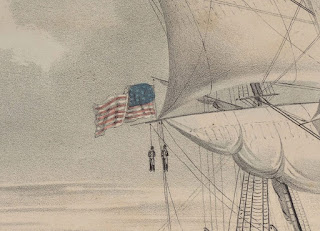
  Philip Spencer is a nineteen year old hard drinking party animal.  He is  a frat boy at sea and a perpetual ne’er do well who has a problem with authority.  He left school as a teenager and ran away from home to find adventure on the high seas, but when his parents caught wind of where he was they quickly had him snatched up and brought back home against his will. Philip’s father told him that if he wanted to go to sea to find adventure he would have to do so as a member of the United States Navy.  Now, in the Autumn of 1842 Philip Spencer finds himself commissioned as an unwilling midshipman in the U.S. Navy aboard the newly launched brigantine the USS Somers .  His father, the man who gave Philip the commission in the United States Navy that he never wanted in the first place, is John Canfield Spencer, a former Congressman from New York and in November of 1842 the current Secretary of War (a position analogous to today’s Secretary of Defense) in the a...