Posts

Showing posts with the label New Jersey

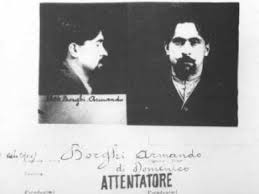
I Have Killed a Principle: The Story of Gaetano Bresci the Anarchist from New Jersey who Shot the King of Italy in 1900
Image
He has been employed as a silk weaver, and fittingly enough, Gaetano Bresci has traveled all the way from Paterson--New Jersey’s ‘Silk City’-- to the land of his birth, a small resort town called Monza located just outside of Milan in northern Italy. It is mid-afternoon on July 29, 1900. Gaetano Bresci is a thirty year old Italian-American immigrant; he’s married to an Irish-American woman named Sophie Kneiland who grew up in Hoboken, with whom he has fathered  two young daughters.  Despite being a devout family man, which by all accounts Gaetano Bresci most definitely was, he is also an anarchist. He had immigrated to New Jersey several years before after running afoul of Italian legal authorities for publishing supposedly dangerous and insurrectionist anarchist literature.  Bresci eventually settled in Paterson, New Jersey, a hotbed of anarchist meetings and activity in the United States, where he was able to not only continue to carry on his war against all world...
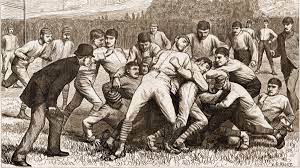
November 30, 1876 the First Thanksgiving Day Football Game: How New Jersey Helped Create an American Tradition

Image
  November 30, 1876, Thanksgiving Day, is cold and wet in northern New Jersey.  Temperatures in Hoboken that early afternoon are near freezing, and an icy sleet is falling. About 1,000 fans have gathered outside on what is called the St. George’s Cricket Ground on this Thanksgiving Day to watch twenty-two collegiate athletes, eleven students from Princeton and eleven from Yale, faceoff in the first ever Thanksgiving Day American gridiron football game. Some sources say the game was played, like modern American football by teams of eleven-on-eleven, though others say that there may have been as many as fifteen players per side, but whatever the number, the game played on that cricket ground that day was unique enough to be considered something entirely different from other collegiate sports that were popular at the time such as rugby or soccer. Most who gathered at the local cricket grounds in Hoboken, New Jersey that day, were former alumni or simply curious spectators w...

Where New York City and New Jersey's Pirates Went to Die: The Story Behind Gibbet Island

Image
  In the late 17th century,  when New York City was still known to many as Neue Amsterdam, having only recently fallen under British control in 1664; when the Hudson River was still called the North River and the Delaware River was still referred to as the South River, there was a settlement known as Communipaw, on the New Jersey side of the harbor then referred to as the colony of Bergen. Even today, in what is modern day Jersey City, there’s still a neighborhood along the waterfront near Liberty Island sitting in the shadow of the Statue of Liberty that is known as Communipaw.   It is considered to be Jersey City’s oldest neighborhood. In 1896 American author and folklorist Charles M. Skinner, a native New Yorker himself, published a work entitled Myths and Legends of Our Own Land .  In this work he recounted a story called “The Party from Gibbet Island”.  This story centered around the colonial community of Communipaw in present day New Jersey. ...

A Railroad, Walt Whitman, Sand and the First Boardwalk: How Atlantic City became America's Middle Class Playground

Image
  In 1850 local resident Dr. Jonathan Pitney began to promote the idea of Absecon Island, located just off southern New Jersey’s coast, as an ideal seaside medical retreat for many of his patients who suffered from various ailments, everything ranging from tuberculosis to nervous breakdowns. Pitney extolled the healing properties of ocean air and saltwater to all who would listen, and by 1853 Pitney along with civil engineer Richard Osborne, who would be in charge of the building’s design and construction, were able to successfully pitch the idea of building a major seaside resort on Absecon Island in New Jersey to influential financiers and politicians. Within a year of the resort’s construction Philadelphia politicians and railroad investors were persuaded enough by Pitney, Osborne and other New Jersey lobbyists to finance a railway that linked the City of Brotherly Love directly with the Jersey Shore and traversed the whole of the Garden State. On July 4, 1854 by charter o...