Posts

Showing posts with the label 19th century

Pray for Bourdin Blown to Pieces: The Greenwich Outrage of February 15, 1894 History's First Act of International Terrorism

Image
  February 15, 1894 was a brisk winter’s day in late-Victorian Era London. At around 5 o'clock in the afternoon a cold hazy setting sun still hung in the sky and glowed--a dull orange orb suspended in air--like the light of a flickering candle about to be extinguished over Greenwich Park just outside the city center and home to the Royal Greenwich Observatory. The Royal Observatory was located on a prominent hill southeast of downtown London in the affluent suburb of Greenwich and overlooked the bustling River Thames--the lifeline of the late 19th century British Empire.  The Royal Greenwich Observatory (RGO) founded by King Charles II in 1675 literally split the known world in half.  It is the Prime Meridian; the spot on the planet earth from which longitude and the passing of time are measured and which to this very day gives us Greenwich Mean Time and the dates on our calendars. Today, the RGO is a tourist attraction located in an urban parklike setting that attrac...
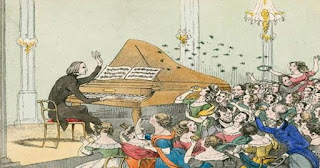
Lisztomania: Before the Beatles or Michael Jackson there was Franz Liszt History's First King of Pop

Image
  “Lisztomania, a condition in which swooning female fans collected his cigar butts to secrete in their cleavages.” - from the New York Times, January 14, 2001 Famed 19th century German lyric poet Heinrich Heine, known for his radical political views and satirical verse that was often set to music, coined the term “Lisztomania” to describe the phenomena that he witnessed in concert halls across Europe during the 1840’s. Lisztomania, or “Liszt Fever” as it came to be called in the English speaking world was a phrase that quickly caught on  among members of the mid-nineteenth century press and public to describe the frenzied adoration, fanaticism, and hero-worship that surrounded the young good looking composer and piano virtuoso Franz Liszt on his yearly concert tours across continental Europe between 1839 and 1847. Young women would creep up behind the young pianist and try to snip off lockets of his hair. Admiring fans would pour the backwash of his coffee cups into gla...

Hudson River's Wrath: The Story of the Great Haverstraw Landslide of 1906 a Natural Disaster Caused by Man

Image
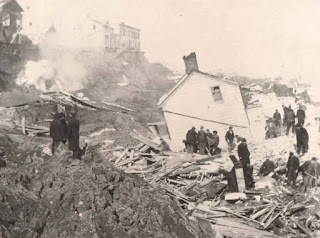
  Located only a stone’s throw north of the New Jersey border in Rockland County, New York, forty miles from Manhattan along the banks of the Hudson River nestled among the Ramapo Mountains, the town of Haverstraw is today a bustling yet still quaint village that is home to about 35,000 souls. Originally settled by the Dutch in the 1660’s Haverstraw derives its name from the Dutch word ‘haverstroo’ meaning oats and straw.  Henry Hudson sailed past the present day site of Haverstraw during his historic exploratory voyage up the river which today bears his name back in 1609.  And during the American Revolution the place that the Dutch called ‘Haverstroo’ was integral to the Patriot cause as it was used by lookouts from George Washington’s Continental Army to monitor British naval activities along the Hudson River. Downtown Haverstraw Today However, it was during the 19th century when Haverstraw first gained notoriety and was brought to the nation’s attention as the bric...